Research: The Effect of Incorporating Motor Current Feedback in an Imitation Learning Policy for a Multi-DOF Robot
Traditional imitation learning for contact-rich manipulation usually uses images and joint positions. This project tests whether gripper motor current, a low-cost proxy for force, when added to an ACT policy improves performance in a task sorting identical soft-vs-hard cubes.
hypothesis + task
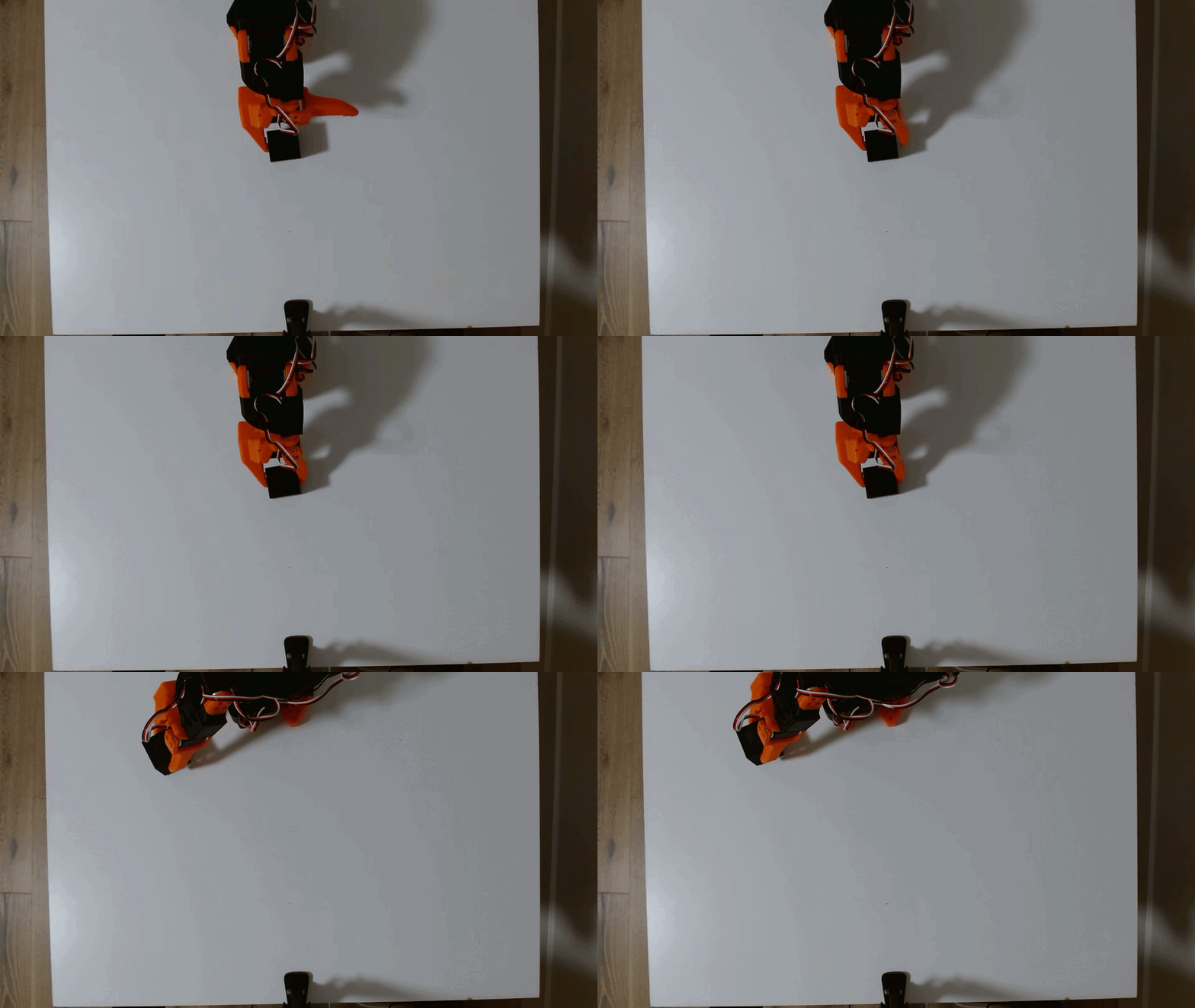
If motor current feedback is included as an input, task accuracy should improve. The robot picks a cube from a fixed point and places it left for soft TPU and right for hard PLA.
materials
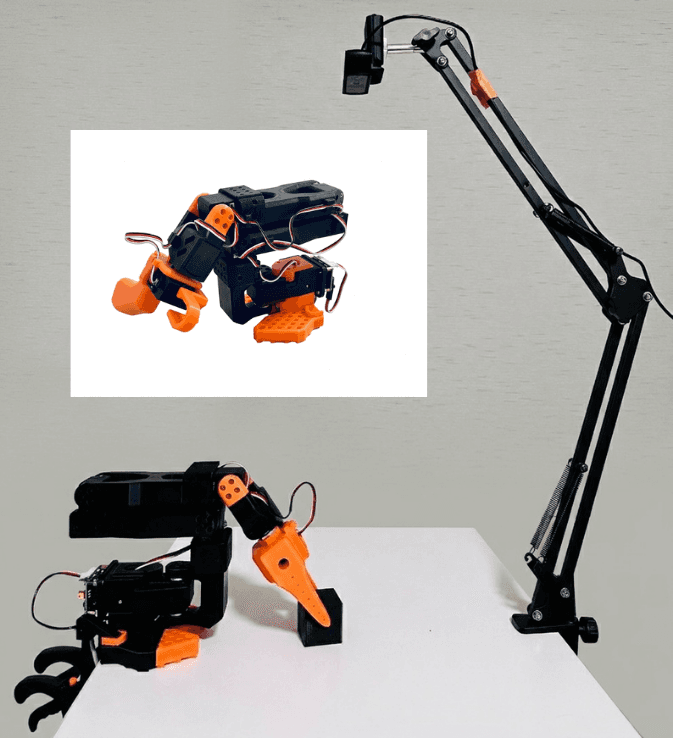
- 2 SO-101 arms (leader + follower)
- Logitech C920x webcam
- LeRobot by Hugging Face
- Google Colab for training
- 1.5 inch TPU and PLA cubes
model + data collection
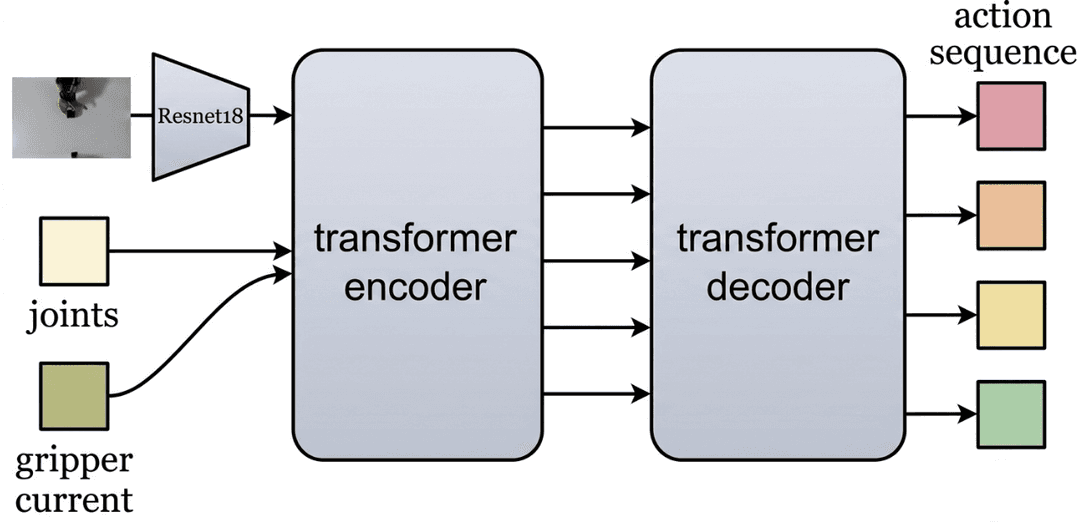
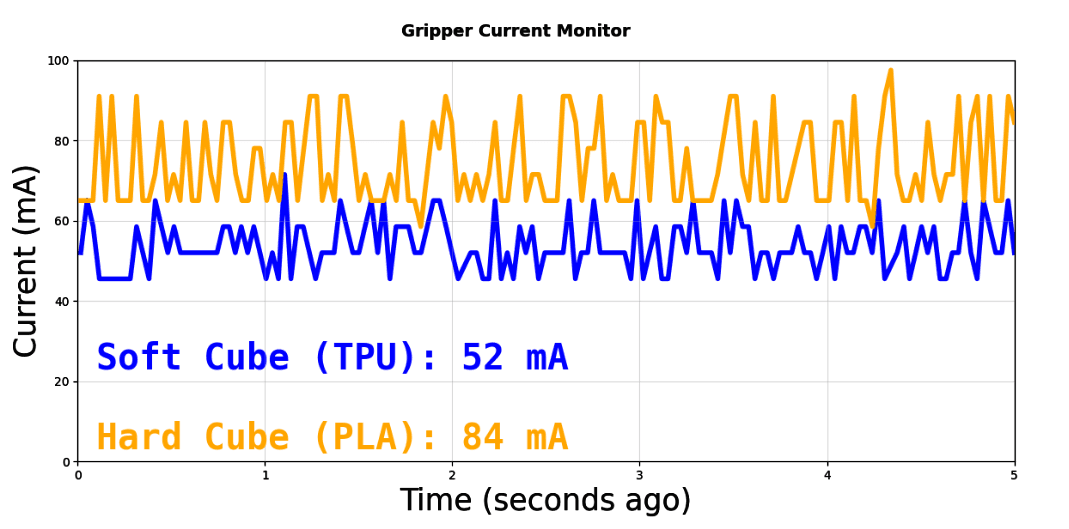
The model uses Action Chunking Transformer (ACT), which predicts action chunks to reduce compounding error. This version appends gripper current to image and joint-state inputs.
Data came from teleoperated 15-second demonstrations at 30 Hz, recording webcam frames, 6-DOF joint states, and gripper current. Total training set: 56 recordings.
training + inference
Baseline and current-augmented models were trained in Colab (about 7 hours each on NVIDIA A100). For baseline control, motor current values were replaced with zeros.
At inference time, the policy generates 100-step chunks every 100 timesteps. Chunk generation is about 0.176s and chunk execution about 3.33s at 30 Hz.
training + inference gifs
PLA
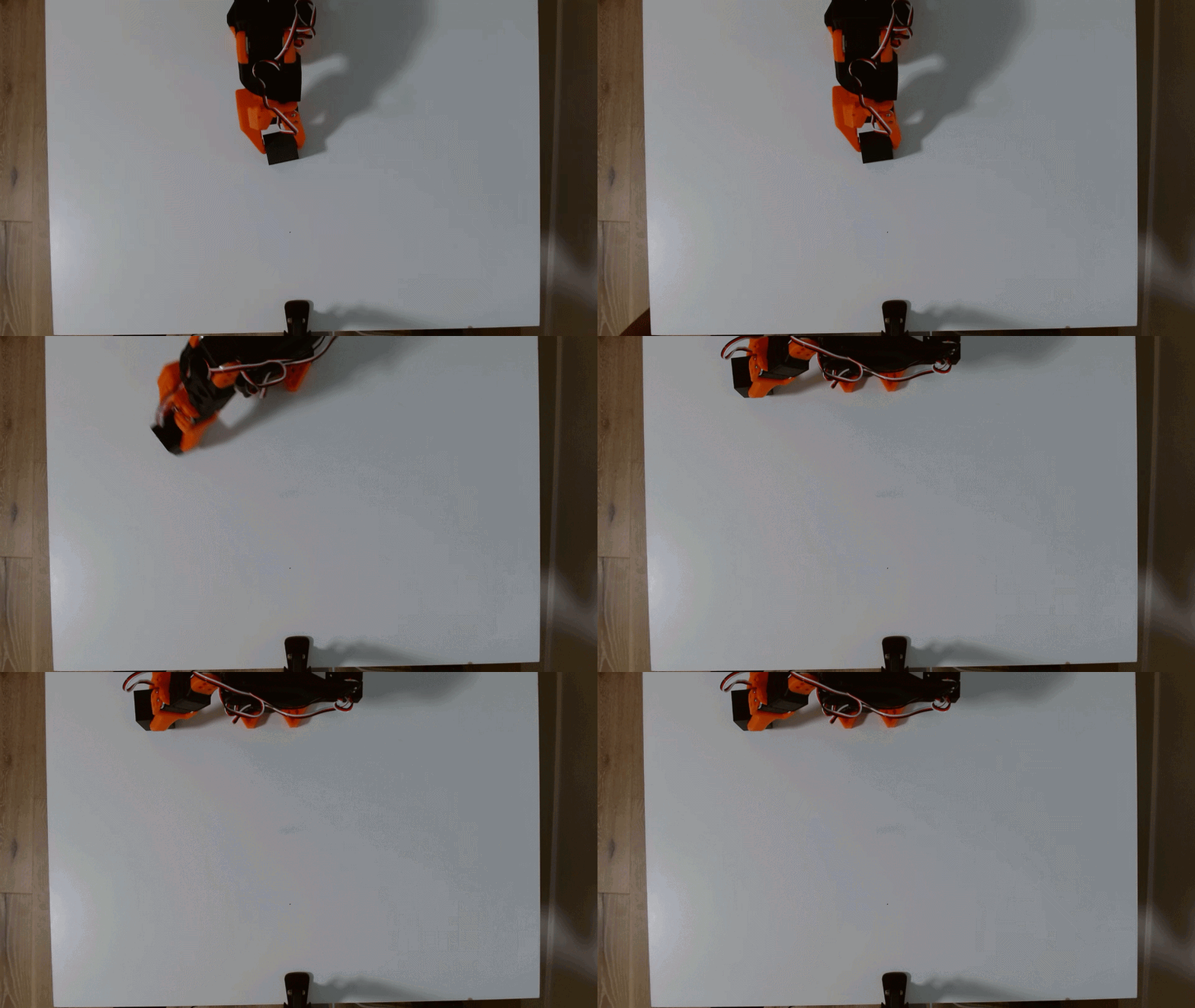
TPU
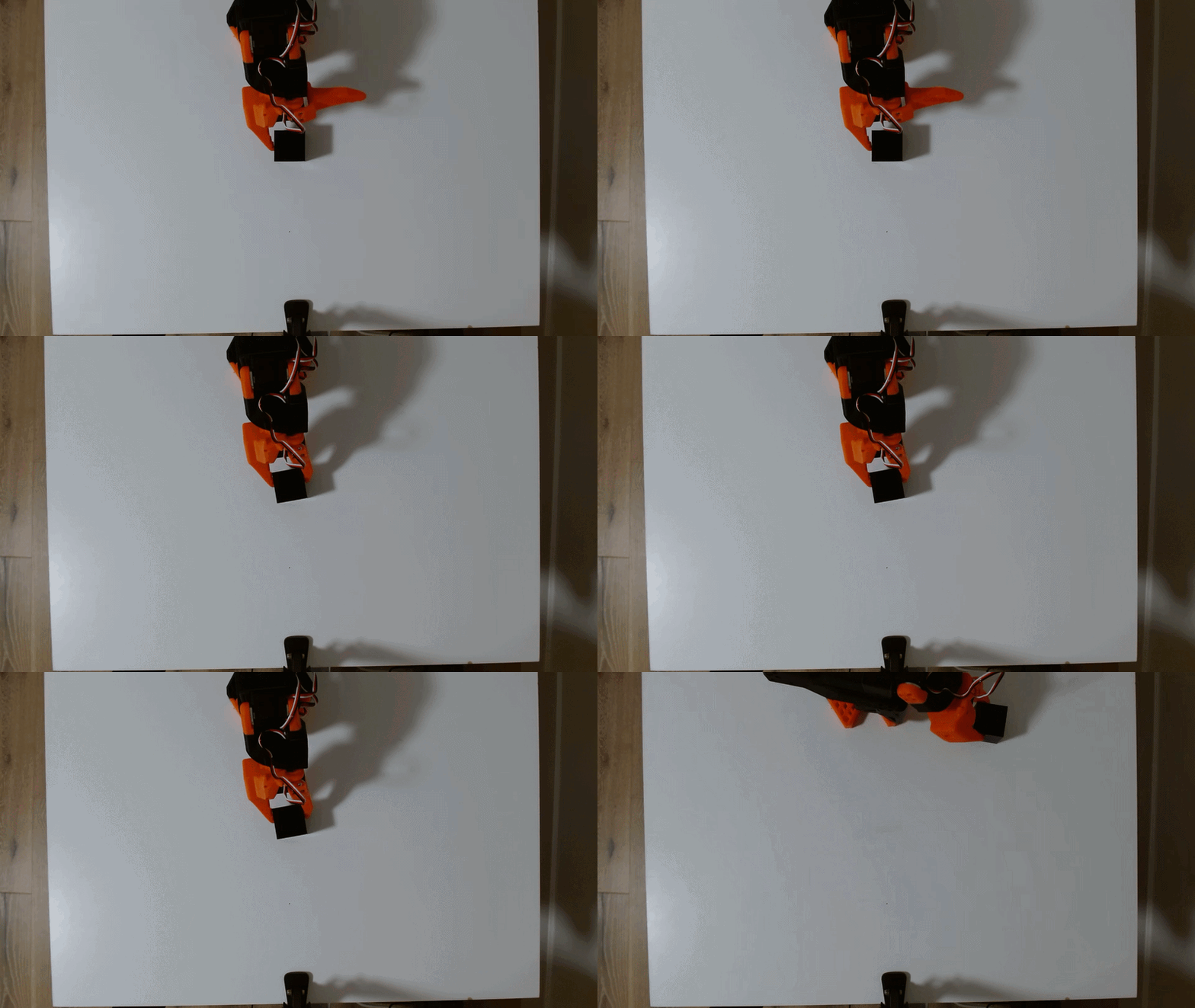
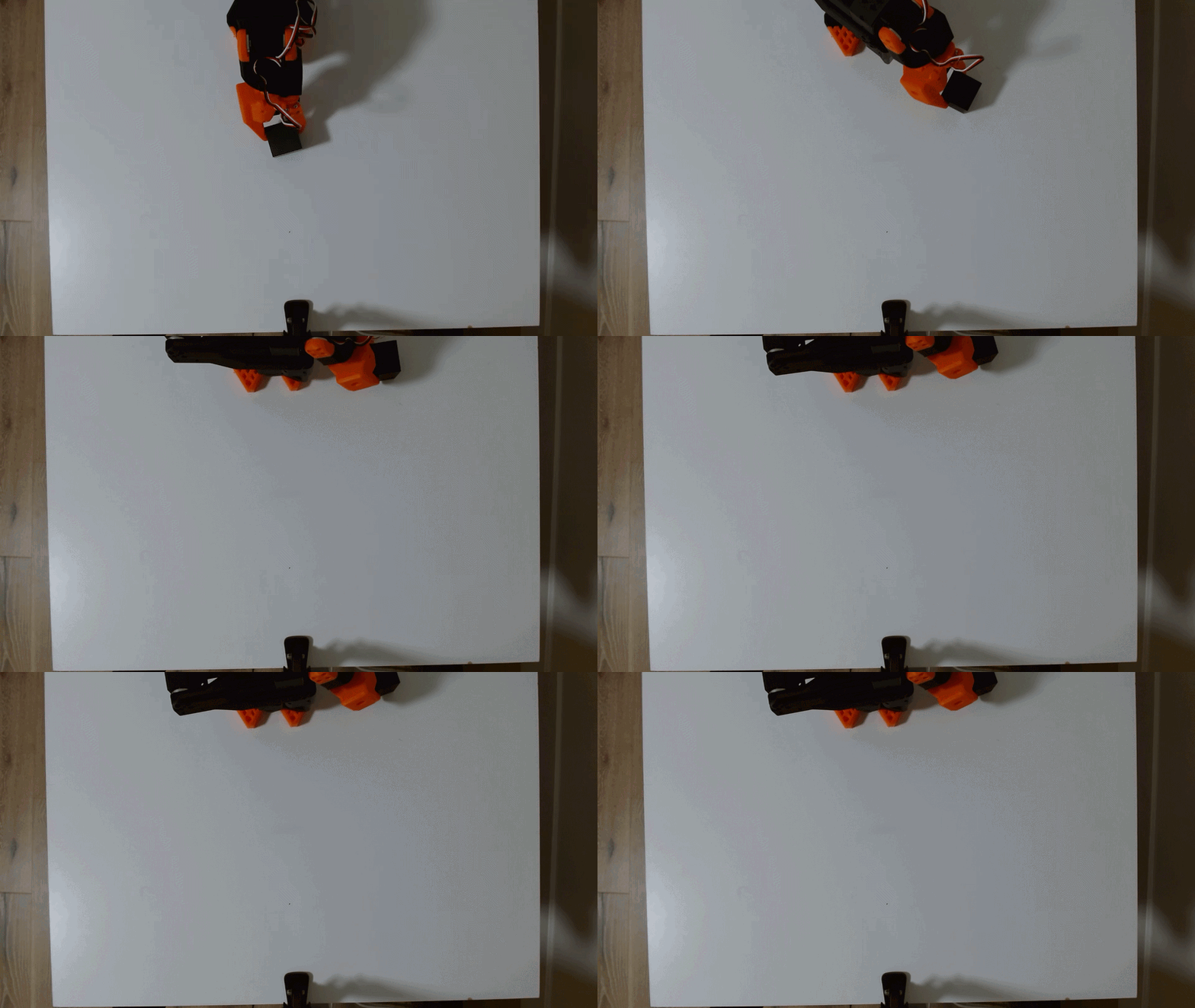
results
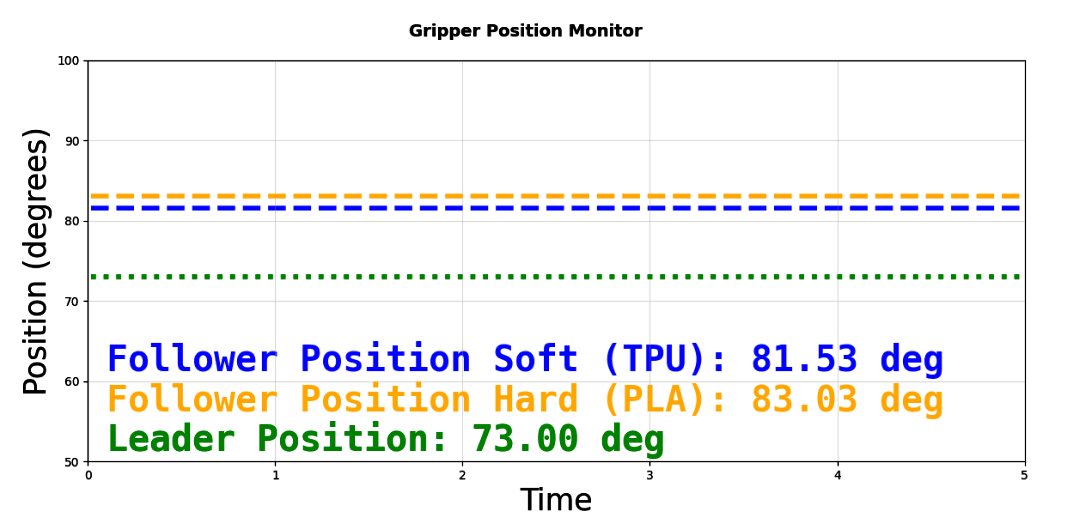
Motor current feedback improved total accuracy from 77.5% to 95%, supporting the hypothesis that current adds useful contact information for distinguishing soft vs hard objects.
| Model | TPU | PLA | Successes | Failures | Accuracy |
|---|---|---|---|---|---|
| Baseline ACT | 15/20 | 16/20 | 31 | 9 | 77.5% |
| Current-Augmented ACT | 20/20 | 19/20 | 39 | 1 | 95% |
conclusions
Motor current provided a strong complementary signal when visual appearance was similar and joint differences were subtle. This improved confidence and task success in low-cost hardware.
further research
- Test visually distinct objects to isolate multimodal effects.
- Include current from all 6 joints for richer contact feedback.
- Validate on practical tasks like fruit picking.
references
- Zhao TZ, et al. (2023). "Learning Fine-Grained Bimanual Manipulation with Low-Cost Hardware." arXiv. Available from: https://arxiv.org/abs/2304.13705
- Tsuji T, et al. (2025). "A Survey on Imitation Learning for Contact-Rich Tasks in Robotics." arXiv. Available from: https://arxiv.org/abs/2506.13498
- He Z, et al. (2024). "FoAR: Force-Aware Reactive Policy for Contact-Rich Robotic Manipulation." arXiv. Available from: https://arxiv.org/abs/2411.15753
- Li Y, Hannaford B. (2017). "Gaussian Process Regression for Sensorless Grip Force Estimation of Cable Driven Elongated Surgical Instruments." IEEE Robotics and Automation Letters, 2(3):1312–1319.
- Kobayashi M, et al. (2024). "ILBiT: Imitation Learning for Robot Using Position and Torque Information based on Bilateral Control with Transformer." arXiv. Available from: https://arxiv.org/abs/2401.16653